
Seiko Leads The Industry For Environments
SEIKO and RoHS
SEIKO WATCH CORPORATION is pleased to announce that it has completed its RoHS* program by voluntarily extending compliance with the EU Directive to all mechanical watches and strap type bracelets, which are not necessarily subject to the Directive. In 2006, SEIKO led the industry in achieving compliance with all its quartz watch production. As of August 2008, this compliance extends to all models, of all movement types, in all brands.
The EU Directive restricts the use of hazardous materials in electrical and electronic equipment and, in particular, required watch makers to eliminate the use of 6 environmentally sensitive substances: lead, mercury, cadmium, hexavalent chromium and two flame retardants, PBB and PBDE**. While many watch companies are still not able to comply and were obliged to seek exemptions from the Directive, SEIKO achieved full compliance in its Spring Drive, Kinetic and quartz watches in 2006. While there is no legal requirement to do so, SEIKO has now succeeded in eliminating all hazardous materials from its mechanical watches and all casing and bracelet components. This achievement again highlights SEIKO’s determination to environmental protection and to leading the industry towards a more sustainable and cleaner future.
* RoHS: Restriction on Hazardous Substances
** PBB: PolyBrominated Biphenyl, PBDE: PolyBrominated Diphenyl Ether
SEIKO's industry-leading green technologies
SEIKO has always sought to develop cutting-edge ’green’ watch making technologies and, with Spring Drive and Kinetic, both of which are exclusive to SEIKO, has succeeded in fusing together high accuracy timekeeping and low environmental impact. Both derive their energy from the natural power of the wearer's motion.
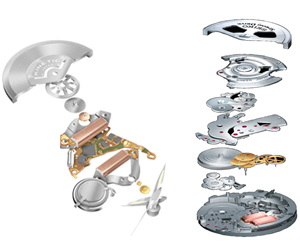
Environmentally-sensitive manufacturing
SEIKO ensures that every component is made to the highest standards of environmental responsibility. SEIKO’s watch manufacturing facilities achieved CFC*** elimination in 1993, and are ISO 14001 accredited and keep on conforming to and exceed the standards set in the EU, WEEE****, Nickel and battery directives.
While many watch companies are still not able to comply and were obliged to seek exemptions from the Directive, SEIKO achieved full compliance in its Spring Drive, Kinetic and quartz watches in 2006.
*** CFC: ChloroFluoroCarbon
**** WEEE: Waste Electrical and Electronic Equipment
Mercury–free batteries
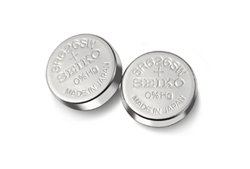
SEIKO has introduced mercury-free batteries since April last year, and June 2008 achieved the commitment that all SEIKO watches would be installed on a production basis. It is the first company to eliminate the use of mercury from watch batteries.
SEIKO and “earthdreams“ initiative by the Honda Racing F1 Team
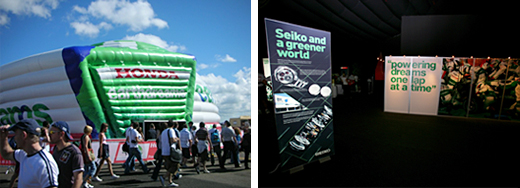
SEIKO supports the Honda Racing F1 Team because we share the team’s values of engineering excellence, commitment to excellence and determination to be the leaders in our respective fields in environmentally responsible activities. It was therefore a natural extension of this partnership for SEIKO to support the 'earthdreams' initiative which the team launched at the British Grand Prix in June, 2008. The purpose of the initiative is to promote green ideas and policies and to support environmental causes worldwide. To date, 1.2 million dollars has been committed to this initiative by Honda, its partners and the public.
SEIKO and the Environment: the story so far
SEIKO WATCH CORPORATION has always been dedicated to minimizing the environmental impact of its activities and products and to improving the global environment:
| - | Since 1969, SEIKO has reduced the power requirement of its quartz watches by 70%. |
| - | In 1993, SEIKO led the industry by eliminating CFC from its manufacturing processes. |
| - | In 1988, SEIKO introduced Kinetic, the only watch in the world to generate electricity by its wearer's movement. |
| - | In 1999, SEIKO introduced Spring Drive, a ’green’ technology that delivers accuracy of 1 second a day, but has no battery. |
| - | Since 2000, SEIKO has annually published an “Environmental Report“ (currently "CSR Report"). |
| - | Since 2001, All SEIKO’s watch production facilities have ISO 14001 certification. |
| - | In 2006, SEIKO achieved compliance with the RoHS Directive. |
| - | SEIKO complies with all EU environmental Directives and regulations, including the RoHS, Nickel, Battery and WEEE Directives. |
| - | In June 2008, SEIKO became the first in the industry to produce all quartz watches with mercury-free button batteries installed. |
| - | In August 2008, all SEIKO watches, even mechanicals, and all bracelet parts became RoHS compliant. |
 Print this article
Related articles
- Mar 4, 2013

Seiko Unveils New Premier Kinetic Collection
At Baselworld 2013, all is new. The magnificent new building will house an entirely new Seiko stand showcasing a new Seiko collection that, like the Fair itself is bigger and more prestigious than ever. With Kinetic Direct Drive, you are the power and you experience the power transfer to the watch in a way that no other watch can match... - Oct 2, 2012

Limited Edition of Seiko Astron GPS Solar Watch Now Available
On Thursday, September 27, 2012, the Seiko Salon in Tokyo opened its doors as usual, but visitors were greeted with a dramatic new display, featuring the new Seiko Astron GPS Solar. Just as the Harrison chronometers that are housed at the Observatory set a new standard of precision and made international travel so much safer, so the new Seiko Astron redefines modern timekeeping by adjusting to every time zone on earth... - Mar 30, 2012

The New Sportura Collection For Women. Where Elegance Meets Performance.
Seiko first met Darya Klishina when she won gold at the IAAF World Youth Championships in 2007, an event that Seiko supported. All four watches have ceramic bezels and each is presented in a unique combination; two have combination bracelets of steel and ceramic and two have high-grade leather straps... - Mar 30, 2012

Seiko Announces New Premier Double Retrograde Chronograph
At Baselworld, 2012, Seiko will introduce its full 2012 collection to the world, and it will demonstrate Seiko’s wide range technical expertise in every area of watchmaking, mechanical, quartz, solar, Kinetic and Spring Drive. Also, the 10 minute chronograph hand counts up to 100 minutes then flies back to 0 minute position to start counting again... - Mar 9, 2012

Grand Seiko Reaches New Heights With A Special Hi-Beat 36,000 Edition
The first Grand Seiko standard was set in 1966, since which time it has been raised as new materials, technologies and mainstream techniques have made possible new advances. Half a century ago, the legend of Grand Seiko was born with the simple idea of creating the ideal watch. Each Grand Seiko watch should be as accurate, as legible, as durable and as easy to wear as humanly possible...



