
Seiko Unveils Electronic Ink Watch With An Active Matrix System
At Baselworld 2005, SEIKO unveiled the world’s first ‘Electronic Ink’ watch. It offered an entirely new kind of display which was ultra-thin, high contrast, and which allowed much higher visibility from a much wider angle (almost 180 degrees). In addition, it required a very low level of power while having a virtually unlimited size of display. This “E-Ink” or EPD* watch excited great interest and won a prize at the “Grand Prix d’Horlogerie de Genève” award ceremony in autumn 2006. Since then, this technology has become much more widely understood and appreciated by consumers, thanks to the increasing popularity of ‘electronic’ books.
The real challenge in the design of the watch was to achieve both a large size of panel which can do justice to the almost infinite display capabilities of the new E-Ink Active Matrix technology, and to make the watch easy to wear.
Today, SEIKO takes this exciting new technology into a new age, with a new generation watch that has an active matrix display. This new display system retains all the legibility benefits of the original, but allows for a much richer range of imagery and data to be displayed on the watch dial.

80,000 Pixels, Each Capable Of Four Different Shades, Deliver 300 Dpi* Of Display
SEIKO is the first and only company to be able to harness Active Matrix EPD technology in a watch. Its display is strikingly clear. Each item of information is three times finer than anything achievable via conventional LCD watch technology and the system allows figures, text and graphics to appear on the dial in a much smoother and infinitely programmable way. For example, the date can be re-sized or laid out differently, according to the amount of information to be displayed in a fixed area. The 2006 ‘E-Ink’ watch had an EPD display made of a few hundred pre-positioned segments, just in black-and-white, while the new one has 80,000 pixels, each capable of displaying in one of four grey scale shades.
The 300 dpi resolution delivers sharp, clear images, even in small sizes.
Comparison of Segment system vs Matrix system:
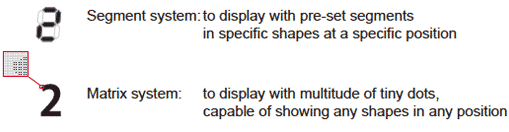
Unequalled Power Efficiency
As users of e-Books will know, the relatively high power consumption of devices with full sized screens limits their power reserve. With this new, second generation EPD watch, however, there is no such concern. SEIKO has succeeded in reducing the power consumption very considerably, such that the watch requires just 1/100th of the power needed to run a same sized display using the current e-Book technology. The key to this achievement lies in SEIKO’s expertise in IC and other hi-tech electronics. Three innovations made it possible.
- 1. A TFT**, which controls the signals to the display
- 2. A low energy IC to control the TFT
- 3. An EPD driver to maximize the potential of E-Ink technology
Large Panel Display
The real challenge in the design of the watch was to achieve both a large size of panel which can do justice to the almost infinite display capabilities of the new E-Ink Active Matrix technology, and to make the watch easy to wear. This has been achieved by making the surrounding area of the display as small as possible. It is just 1mm wide, and the screen area is thus maximized.
This watch is a technology demonstration prototype. The watch to be marketed in autumn 2010 will be a modified version.
Technology Of Epd
EPD stands for Electrophoretic Display, a method of display with electronic ink technology. Electronic ink is a proprietary material that is processed into a film for integration into electronic displays. Although revolutionary in concept, electronic ink is a straightforward fusion of chemistry, physics and electronics to create this new material. The principal components of electronic ink are millions of tiny microcapsules, about the diameter of a human hair. Each microcapsule contains negatively charged white particles and positively charged black particles suspended in a clear fluid. When a negative electric field is applied, the white particles move to the top of the microcapsule where they become visible to the user. This makes the surface appear white at that spot. At the same time, an opposite electric field pulls the black particles to the bottom of the microcapsules where they are hidden. By reversing this process, the black particles appear at the top of the capsule, which now makes the surface appear dark at that spot.
*Dots per inch
**Thin Film Transistor
 Print this article
Related articles
- Mar 4, 2013

Seiko Unveils New Premier Kinetic Collection
At Baselworld 2013, all is new. The magnificent new building will house an entirely new Seiko stand showcasing a new Seiko collection that, like the Fair itself is bigger and more prestigious than ever. With Kinetic Direct Drive, you are the power and you experience the power transfer to the watch in a way that no other watch can match... - Oct 2, 2012

Limited Edition of Seiko Astron GPS Solar Watch Now Available
On Thursday, September 27, 2012, the Seiko Salon in Tokyo opened its doors as usual, but visitors were greeted with a dramatic new display, featuring the new Seiko Astron GPS Solar. Just as the Harrison chronometers that are housed at the Observatory set a new standard of precision and made international travel so much safer, so the new Seiko Astron redefines modern timekeeping by adjusting to every time zone on earth... - Mar 30, 2012

The New Sportura Collection For Women. Where Elegance Meets Performance.
Seiko first met Darya Klishina when she won gold at the IAAF World Youth Championships in 2007, an event that Seiko supported. All four watches have ceramic bezels and each is presented in a unique combination; two have combination bracelets of steel and ceramic and two have high-grade leather straps... - Mar 30, 2012

Seiko Announces New Premier Double Retrograde Chronograph
At Baselworld, 2012, Seiko will introduce its full 2012 collection to the world, and it will demonstrate Seiko’s wide range technical expertise in every area of watchmaking, mechanical, quartz, solar, Kinetic and Spring Drive. Also, the 10 minute chronograph hand counts up to 100 minutes then flies back to 0 minute position to start counting again... - Mar 9, 2012

Grand Seiko Reaches New Heights With A Special Hi-Beat 36,000 Edition
The first Grand Seiko standard was set in 1966, since which time it has been raised as new materials, technologies and mainstream techniques have made possible new advances. Half a century ago, the legend of Grand Seiko was born with the simple idea of creating the ideal watch. Each Grand Seiko watch should be as accurate, as legible, as durable and as easy to wear as humanly possible...



